
One hardware family. One platform. Three planned tiers.
This page is the overview: what IrrigAims actually is, in product terms. For the deep dives, see Technology for the pod hardware and Platform for the dashboard software. Pricing is published below in the marketplace, priced by the line and quoted per site.
AgroSense: the field pod family.
One solar-powered sensing and control unit, sold at three levels of capability. The base hardware is the same bench-validated prototype described on Technology; what changes between tiers is which software layer runs on top of it.
AgroSense Planned tier
Base sensing and control: the 8-in-1 soil probe, air quality, camera, closed-loop pump and valve actuation, LoRa connectivity. No AI layer beyond the on-hub decision forests already described on Technology.
AgroSense+ Planned tier
Everything in AgroSense, plus the programme-year AI layer: WaterIQ, NutrientIQ, AgroBrain, FertiBrain and the rest of the twelve features on Intelligence, each labelled by its real maturity.
AgroSense Pro Planned tier
Everything in AgroSense+, plus fleet-scale features: multi-site management, the Savings Ledger's audit-grade export, and the reporting a commercial or municipal client needs across many pods at once.
Tier names and scope are the current plan. See Investors for the business-model direction.
The Intelligence Platform.
Every tier connects to the same dashboard: live telemetry, irrigation and fertigation control behind a confirm-before-command safety model, the WaterIQ advisor, the Savings Ledger, and Dwani. The dashboard is open to explore right now.
- Live field telemetry and a 48-hour history for every sensor the pod carries
- Zone-by-zone irrigation and dosing control, with typed confirmation on anything that actuates hardware
- WaterIQ, NutrientIQ and AgroBrain recommendations, each showing its reasoning
- The Savings Ledger, with its formula, baseline and gaps disclosed on every figure
- Dwani, a conversational preview answering from the site's own live data
Hardware senses. Software decides. Together, they close the loop.
The pod alone is a sensor. The platform alone is a screen. IrrigAims closes the loop between them: sense, decide, water, feed, correct pH, then verify what was saved, described in full on the homepage.
One chassis. Pick the parameters your site needs. One hub, in two builds.
Every site starts with one hub, irrigation only or irrigation plus fertigation, and one pod per zone — a base chassis plus only the sensing your crop and your water demand actually need: start with soil moisture, add EC, pH, N-P-K or air & dust as add-ons. Nothing is bundled you didn't choose — you pay by the parameter, not by the bundle.
The pod senses & processes
Every reading (soil, air, imagery) is sensed and processed on the pod's own ESP32-S3, on solar power. It has no mains power and no actuation of its own: it transmits the result over km-class LoRa (module spec, field range to be validated) and nothing else.
The hub runs the models & acts
Mains-powered, the hub receives every pod on site, runs the models trained on their data, and is the only unit that actuates: opening the valve, driving the pump and, on the fertigation build, dosing N, P or K. A site buys one hub, in the build it needs, then adds pods as it grows.
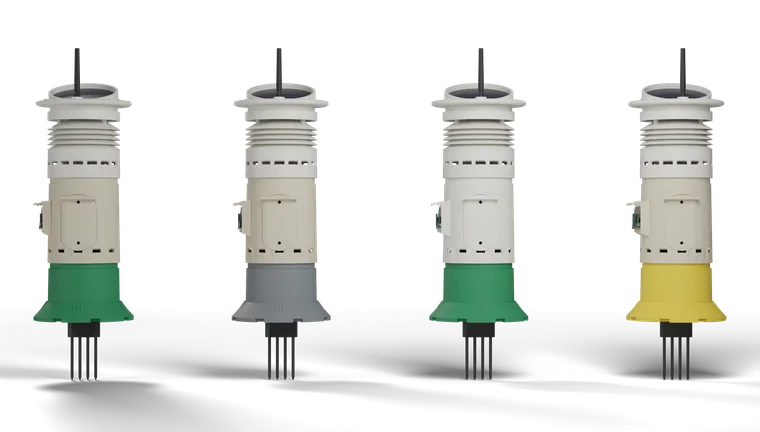
A base chassis, plus the options your site needs.
The split below is arithmetic, not opinion: chassis, the full soil-sensing ladder and the air & dust module add to exactly AED 1,010, the fully-fitted pod price — and every step in between is just the sum of what you picked.
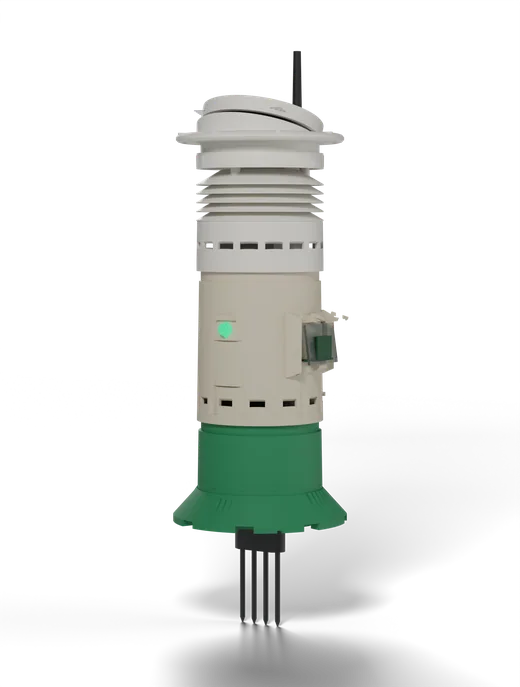
Pod chassis
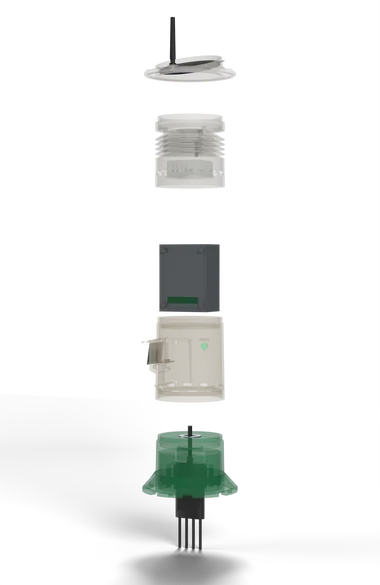
Sealed electronics core in a free-draining shroud. Solar, sub-GHz radio, on-board camera, status light, 5-year Gulf materials spec.
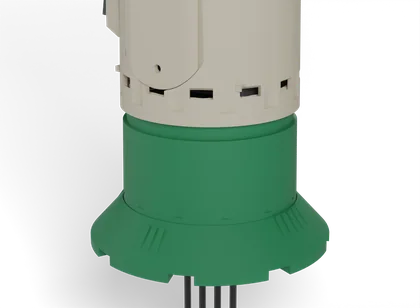
Soil sensing, by the parameter
Moisture · temperature · EC · salinity · pH · N-P-K
Samples 24–84 mm down: root zone, not surface crust. Start with the moisture + temperature entry sensor and add only the parameters your crop needs:
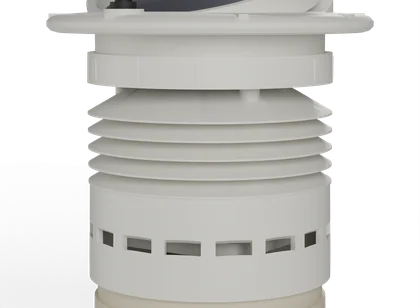
Air & dust module
Air temperature · humidity · PM1–PM10 · VOC
Air temperature drives ET₀ and VPD. Particulate feeds the irrigation model directly. See why below.
The split is arithmetic, not a discount — the fully-optioned pod is exactly the sum of its three lines.
One shell, sealed core, nothing hidden.
The chassis and its two options share one moulding and one board family: adding a sensor is a BOM line, not a different product.
One hub per site, in two builds.
The hub receives every pod, runs the models on site, and is the only unit that actuates anything: a valve, a pump, a dosing channel.
Hub: irrigation
Receives from every pod, runs the models on site, drives the valve and pump. Flow measurement and the hard safety limits live here, beside the water they control.
Hub: irrigation + fertigation
Adds three peristaltic dosing channels for N, P and K, with their driver stages. Nutrient decisions act on the same closed loop.
The rest of the line — quoted per site.
These have no published figure yet: each is scoped and priced against your site, in the same pilot quote.
Replacement 8-in-1 soil probe
A field-swappable probe head for a pod already in the ground.
Spare air & dust module
The louvered air/particulate sensor as a standalone replacement part.
Peristaltic dosing pump (fertigation)
An N, P or K dosing channel and its driver stage for the fertigation hub.
Pod mounting / ground-stake kit
The stake and bracket that fixes a pod in a zone at sensing height.
Installation & commissioning
On-site setup, pod-to-hub pairing and the metered baseline that opens a pilot.
Design choices we're not walking back.
Both of these read like limitations at first. They're deliberate. Here's the reasoning behind each one.
The air module can't be switched off on AgroSense+ or Pro.
The on-device irrigation model takes dust as an input feature: the exported decision trees split on it 65 times in the duration regressor. Without the air & dust module, that model cannot run, so the AI tiers require it rather than pretending to work without it.
Safety is never behind the paywall.
Irrigation control, dry-run cutoff and leak detection all ship in the included AgroSense tier. Paywalling the thing that stops a flood is how you get blamed for the flood.
Three tiers of intelligence. Same pod and hub underneath.
The hardware above doesn't change between tiers. What changes is which layer of the platform runs on top of it — and the monthly price for that layer.
| Feature | AgroSense included Included free with every pod, for the life of the pod | AgroSense+ the AI layer AED 48 / pod / month positioned under half of CropX's USD 275–399 per sensor per year · requires the air & dust module | AgroSense Pro multi-site AED 71 / pod / month + AED 140 / site / month adds fleet-scale management and audit-grade reporting · requires the air & dust module |
|---|---|---|---|
| Live readings + 48h history | Included | Included | Included |
| Threshold irrigation control | Included | Included | Included |
| Dry-run & stuck-valve cutoffs Live · on-device safety limits | Included | Included | Included |
| Leak detection Building · not deployed | Included | Included | Included |
| Email alerts Live · rules | Included | Included | Included |
| Crop identification from pod photos Live · trained model | Not included | Included | Included |
| Per-crop irrigation + fertigation conditioning Live · trained model | Not included | Included | Included |
| SaltGuard: FAO leaching requirement folded into duration Live · FAO standard | Not included | Included | Included |
| Sensor trust scoring Building · not deployed | Not included | Included | Included |
| Overnight model retraining | Not included | Included | Included |
| Multi-site management | Not included | Not included | Included |
| Audit-grade water + carbon reporting | Not included | Not included | Included |
| Baseline savings ledger Live · metered maths | Not included | Not included | Included |
| API access + data export | Not included | Not included | Included |
| Priority support | Not included | Not included | Included |
| Requires the air & dust module | Not required | Required | Required |
The top-of-page tier cards and this matrix describe the same three Planned tier plans; software is a planned subscription, quoted per site.
How many pods does your land need?
These are planning estimates, not a rule: the real number comes off a valve or hydrozone map, and every default here is overridable once we see your site. The configurator above uses exactly these four densities.
| Site type | Planning density | Why |
|---|---|---|
| Open field / farm | ~1 pod / 5,000 m² | One pod per irrigation zone. Area fallback assumes 0.5 ha zones. |
| Greenhouse / protected | ~1 pod / 500 m² | Denser: a protected house has tighter zones and higher crop value. |
| Landscape / municipal | ~1 pod / 2,000 m² | One pod per hydrozone. This is the segment that pays a metered water tariff. |
| Indoor / vertical | ~1 pod / 250 m² | Bench-block density. Note the soil probe suits substrate, not deep hydroponics. |
Planning estimates, overridable per site, not a published rule. One hub per site either way; pods scale with zones, not area.
Every site type maps to a segment.
The four densities above line up with the buyers on Solutions. Pick the one that sounds like you.
Farms
Need-based irrigation and fertigation per zone, with salinity feeding the dose.
See the farm segment →Villas, landscape & municipal
One pod per hydrozone, a fleet view across sites, and metered-tariff water reporting.
See the landscape segments →Indoor & vertical
Bench-block density for protected growing; the soil probe suits substrate.
See the indoor segment →Government & research
Protected-house density with source-cited data aligned to national water strategy.
See the research segment →Every hub-and-pod site connects to the same Intelligence Platform: a live dashboard, all twelve Phase-1 AI features, models that retrain nightly against real field data, and the Savings Ledger with its formula, baseline and gaps disclosed on every figure.
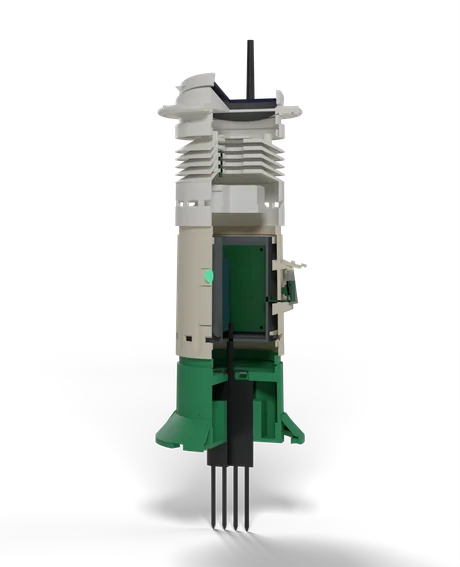
The production pod, open on the bench.
v3 stops sealing the body. v2 was a sealed tube whose 1.4 litre cavity breathed humid air past its weakest gasket every night and rained on its own board by morning — a failure usually misread as a radio fault. In v3 the barrel is a ventilated, free-draining shroud and the electronics live in one small sealed can inside it: sealed joints in the pressure boundary drop from four to one, the cell leaves the sunlit skin, and the air sensor breathes real outside air instead of the enclosure's own microclimate. The schematics and this interactive model are published, not promised.
Two boards
A camera head board so the lens looks outward, and a main board carrying power, radio and the probe bus.
E32 radio
Switched to the module proven on our own bench, with the antenna leaving through its SMA connector.
CN3058E charging
Solar charge path specified from the datasheet, sized for LiFePO₄ in 60 °C summers.
KiCad, verified
Complete schematics with a connection table and BOMs for both boards, pin order checked against datasheets.
Field watches one view. Scout sweeps the row.
The same head board either bolts behind a sealed window or rides a servo turntable, sharing one BOM line and one firmware image. The difference between them is mechanical.
| Specification | Field | Scout |
|---|---|---|
| Camera mounting | Fixed behind a flat sealed window | Servo turntable behind a clear band |
| Moving parts | None | One servo |
| Coverage | One fixed view | ±170° sweep, stitched panorama |
| Height | ~262 mm | ~308 mm |
| Sealing | Flat bonded pane | Clamped band, two O-rings |
| Added cost over field | — | Servo, clear ring, 10-way FFC |
The pod in your pocket, and it degrades instead of breaking.
A native iOS app built around one rule: the things that matter must not depend on a language model being reachable. Watering commands are deterministic and local; the conversation layer is a bonus on top.
Commands never wait on AI Live · on-device safety limits
“Water for 60 seconds”, “stop”, “auto mode” are parsed locally and executed straight against the pump, with the firmware's own failsafes underneath. No model in that path.
Dwani, three layers deep Building · needs the server key
Live telemetry and the camera frame go to a server-side proxy so no key ships in the app. Without that key it falls back to a local, data-grounded engine rather than failing.
Insights without a cloud Building · metered maths
LeakSense, SensorGuard and the savings figure are computed on the phone from the history feed: pump commanded but no flow, a sensor gone silent, litres against a timer baseline.
Want to see it running on your site?
Pilots start with a metered baseline. No pricing commitment is needed to talk.